

For more than a decade, there has been one very special member of the Acacia…
Making Education More Accessible
An old double garage stood quietly at the edge of Tigh Fruin, its doors stiff with disuse and its walls echoing with nothing but dust and possibility. Most people would have walked past it without a second glance. But in 2024, Paul Routledge, our Director of Education, saw something different.
He didn’t see a forgotten building – he saw a future.
For the young, autistic adults living at Tigh Fruin, near Retford, education had always come with a cost – physically and emotionally. A three-hour round trip to the main Calman Colaiste College in Peterborough meant long days, disrupted routines, and energy drained before learning could even begin.
Education is essential – everyone knows that. It opens doors to independence, confidence, and a meaningful place in society. But for these learners, the journey itself was often the biggest barrier.
Paul had an idea: what if education came to them instead?
Education is key for any person. It helps develop essential skills, personal development, economic opportunities, and social mobility and interaction.
This is even more so for autistic individuals as it not only provides these skills, but gives them a structured environment that can help them develop and foster their unique strengths and aids their overall development, enabling them to participate in society and lead fulfilling lives.
Education for the young adults we support is mainly provided at our Calman Colaiste College in Peterborough and is based upon personal goals and promoting independence.
Paul contacted Nicola Lilley, who was working at our Swinderby School, in July 2024, to see if she would be willing to set up the satellite college and she jumped at the chance – not because it would be easy, but because it mattered.
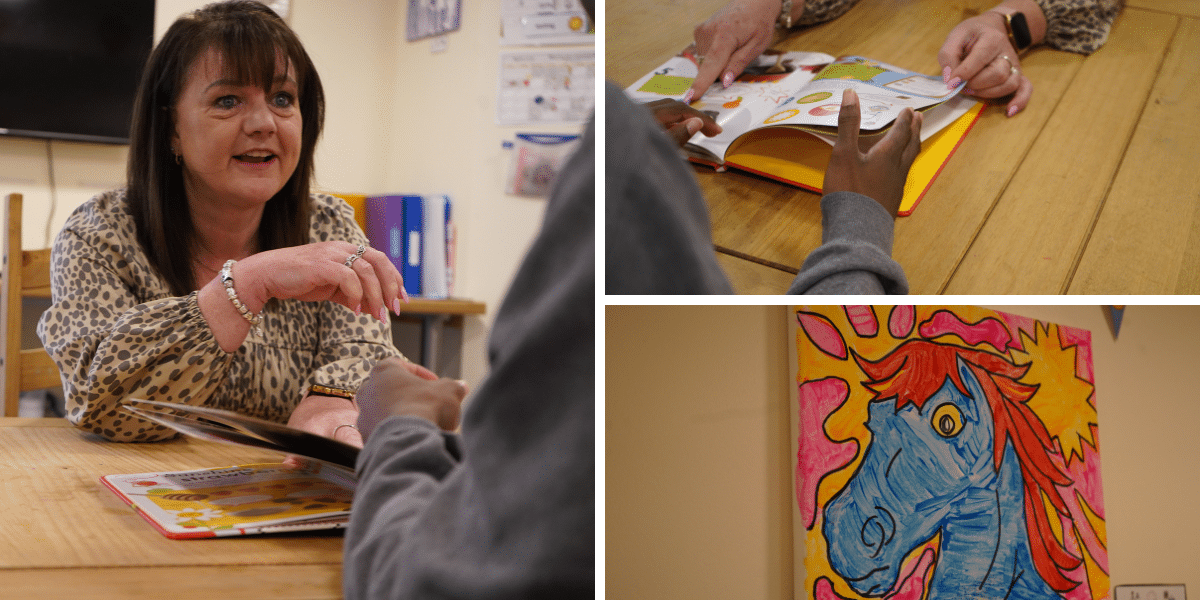
“It was an old double garage and was basically a blank canvas”, said Nicola. “We had two months to get it decorated, get all the learning equipment in, organise the timetables and get it looking something like a classroom before the term started in September 2024.”
That summer of 2024 was hectic. Bit by bit the building was decorated, a TV was installed, learning equipment and displays were put up, and documents and resources like art and maths equipment were brought in to make it look like a nice, warm environment for the learners.
By the time term began, the room was ready.
So were the learners.
At first, there were only two. Just two students sitting in a small classroom that had once housed nothing at all. But something remarkable began to happen. Without the noise and distractions of a larger college, progress came quickly. Confidence grew. Skills developed. Today, there are four learners – and each one has taken strides that once felt out of reach.
The curriculum is delivered exactly the same as what they would receive at the main Calman Colaiste College, but unlike the larger college where there can be a lot going on, there are no distractions here which has really helped with their progress.
Nicola’s background is in education, compliance and care; roles that have proven valuable and helped her develop the college.
Nicola said, “I have seen what happens in homes and what should be done, that’s why I think I was chosen for this role – because of my knowledge and experience.
“I have always said that the key thing about the curriculum is that it’s based around promoting independence. It embeds basic education with community participation and work-related learning. This could be anything from helping out on a farm to working in a charity shop, the sort of thing that aids their personal development, functional skills and creativeness.”
Nicola understood that education isn’t one-size-fits-all, it must be tailored to meet an individuals needs. Some learners thrive with structure at a desk. Others need movement, real-world hands-on experience. So, the lessons adapted.
Maths wasn’t just numbers on paper – it was counting apples in a shop.
Cooking wasn’t just following instructions – it was planning meals, budgeting, and choosing ingredients in the local supermarket.
Community trips weren’t outings – they were classrooms without walls.
Learning became something you could see, touch, and live.
Nicola added, “I think that’s the key point I want to try and get out of this, that even though the curriculum’s there, we don’t have to rigidly stick to it! It is about the individuals. It is about personalising the curriculum and making it work for our learners.”
Another major milestone for the learners has been taking part in the Duke of Edinburgh Award. One is working on their bronze, two have already completed the bronze and are now on silver and one is working towards the gold – something which would have been unimaginable if it had not been for the education they receive at the college.
A key element of the college’s success has been the close working relationship between the main college, the satellite college and the home (Tigh Fruin). The team ethos has helped build not only a learning environment, but a nurturing one as well, where the skills they learn in the classroom are transferable into the home.
So, what was a dusty old garage is now a thriving hub of activity, that hums with conversation, laughter, and the small but significant victories of everyday learning. It holds stories of progress – of learners who are discovering what they can do, at their own pace, in their own way.
When asked to reflect on the progress made, it wasn’t the physical building or the curriculum, it was the learners that gave Nicola so much joy. “I’m proud of everyone. I’m proud of all the people we teach and the progress they have made over the past two years.
“They really are the luckiest learners in the organisation because they are a small group and basically have one-to-one teaching. But, at the end of the day, what we do, it’s all about the people we support. Giving them that independence, providing them with the skills to do everyday tasks and providing them with a better and more meaningful life – and you can really see the progress they have made.”
If you look at this story, it is not about that dusty old garage.
It is about removing barriers, rethinking education and providing that small, but essential piece of the jigsaw that gives someone their independence.

Related Posts